
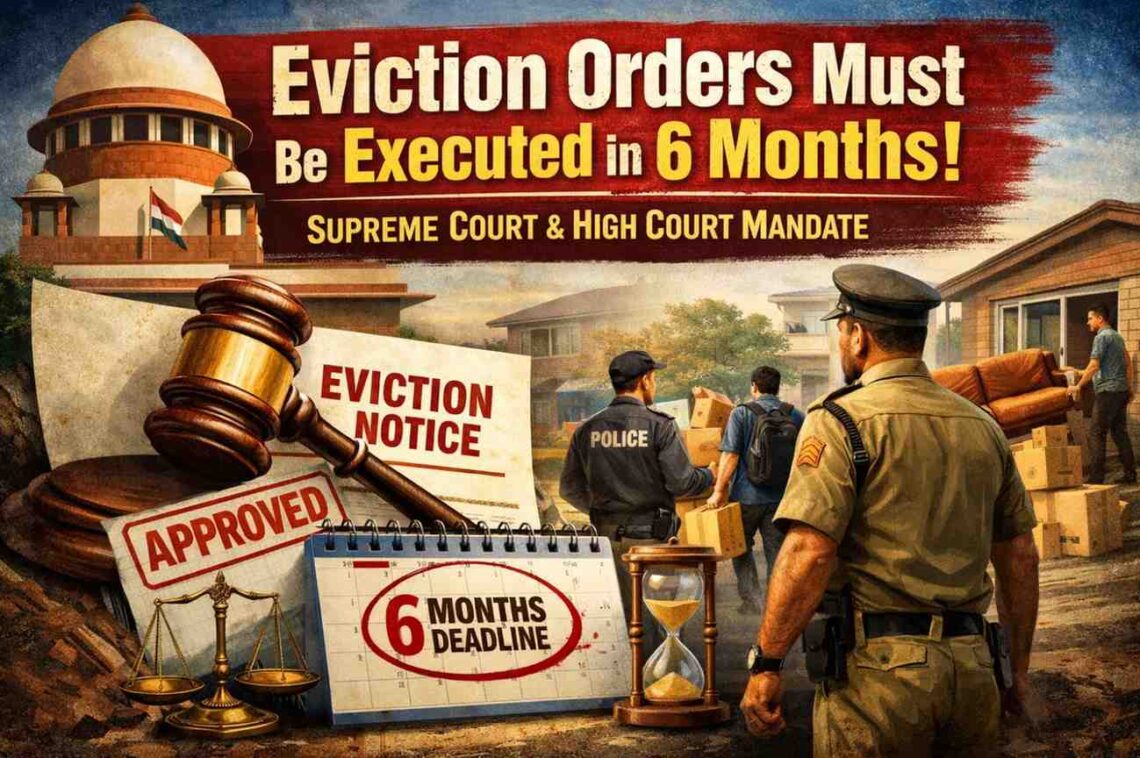
For years, the legal process of reclaiming property through eviction has been criticized for being slow and cumbersome. Of course, this criticism is not without foundations. Even after a landlord successfully obtains an eviction decree, the actual recovery of possession can remain stalled in the execution phase. However, the High Court of Madhya Pradesh, in its recent judgment in Anil Kumar Kushwah vs. Anil Kumar Gupta (2026), has issued a powerful directive intended to eliminate these delays and ensure that justice is delivered swiftly.
The Core Mandate: A Six-Month Deadline
The High Court has established a strict administrative and judicial timeline for the execution of eviction orders. Every executing court is now mandated to dispose of execution proceedings within six months from the date they are filed. Extensions beyond this period are only permitted in exceptional circumstances, and the presiding officer must record specific reasons for any such delay in writing.
This directive is not merely a guideline but a mandatory administrative requirement. The High Courts across the country are directed to collect data regarding pending execution petitions and issue circulars to their respective district judiciaries. Under these orders, presiding officers who fail to comply with the six-month disposal rule will be held answerable to the High Court on its administrative side.
Guidelines for Executing Courts
To achieve this accelerated timeline, the Court reiterated several mandatory guidelines for conducting execution proceedings:
- Initial Examination: Courts must examine the parties early in the suit under Order 10 of the CPC to identify any third-party interests.
- Document Disclosure: Parties must be required to disclose and produce relevant documents under oath.
- Unambiguous Decrees: Before passing an eviction decree, courts must ensure the description of the property is clear and unambiguous to prevent confusion during execution.
- Police Assistance: If a decree cannot be executed without police intervention, the court has the authority to direct the local police station to provide necessary assistance.
- Discouraging Frivolous Objections: Courts must not mechanically issue notices on third-party claims and should refrain from entertaining applications that raise issues already decided during the main suit13.
- Compensatory Costs: If an objection or resistance to eviction is found to be frivolous or made in bad faith, the court may award compensatory costs.
The Judicial Reasoning
The mandate is based on the principle that the fruits of a hard-won decree should not be denied to a litigant through procedural stagnation. The High Court cited the Supreme Court’s observations in Rahul S. Shah and Periyammal vs. V. Rajamani (2025), which emphasize that execution is the final stage of justice and must be conducted with efficiency and transparency.
In the specific case of Anil Kumar Kushwah, the High Court set aside lower court findings that had denied an eviction decree despite the landlord proving both a genuine residential need and a default in rent payments by the tenant. By ordering the tenant to vacate within one month and mandating a six-month window for execution if necessary, the Court signaled a new era of accountability in property law.
Implications for Property Owners and Tenants
This ruling provides property owners with a more predictable and efficient legal path to reclaiming their property. It significantly reduces the potential for tenants to use “tactic-based delays” to stay in a premises after an eviction order has been issued. For legal practitioners, it necessitates a more diligent approach to documenting property details and addressing third-party interests at the very start of the litigation.
This mandate serves as a reminder that the judicial system is evolving to prioritize the timely enforcement of legal rights, ensuring that an order from the court is not just a piece of paper, but an effective remedy.
Frequently Asked Questions:
No. The High Court of Madhya Pradesh ruled that the legal profession is a professional activity driven by personal skill and intelligence, not a trading or commercial activity. If the office is situated in a residential building, it remains a professional use and does not change the nature of the building to commercial.
Yes. Since an advocate’s office in a residential building is not a commercial activity, a landlord can seek eviction on the grounds of bona fide residential need. This is applicable if the landlord proves a genuine requirement for themselves or their family members, such as a student’s study room.
The High Court has issued a mandatory directive that executing courts must dispose of execution proceedings within six months from the date of filing. Any delay beyond this period requires the presiding officer to record specific reasons in writing.
No. Under Section 96 of the CPC, an appeal lies only against a decree, not mere findings. If a tenant is successful in the final result but aggrieved by a specific finding, they should file a cross-objection or a civil revision rather than a separate appeal.
Yes. Under Section 13 of the M.P. Accommodation Control Act, a tenant is protected only if they regularly deposit rent during the pendency of the suit or appeal. Failure to pay or deposit rent, even for a few months, can lead to a decree for eviction regardless of other defenses.
Courts do not condone delays in rent deposits based on mere sympathy. A tenant must show “sufficient cause” through a formal application. For professional tenants like advocates, the court holds a higher standard, often rejecting pleas of “factual confusion” or “legal ignorance”.
Read Full Judgment.
Disclaimer: This post is for informational and educational purposes only. It does not constitute legal advice, financial advice, or professional advice of any kind. Laws and their interpretation may vary depending on facts, circumstances, and jurisdiction. Neither Siddharth Shukla, Advocate, nor any associate, partner, or member of Siddharth Shukla Office, Jabalpur, accepts any responsibility or liability for any loss, damage, or consequence arising from reliance on this content. Readers are strongly advised to consult a qualified lawyer or appropriate professional for advice specific to their situation. Reading this content does not create a lawyer–client relationship.

