
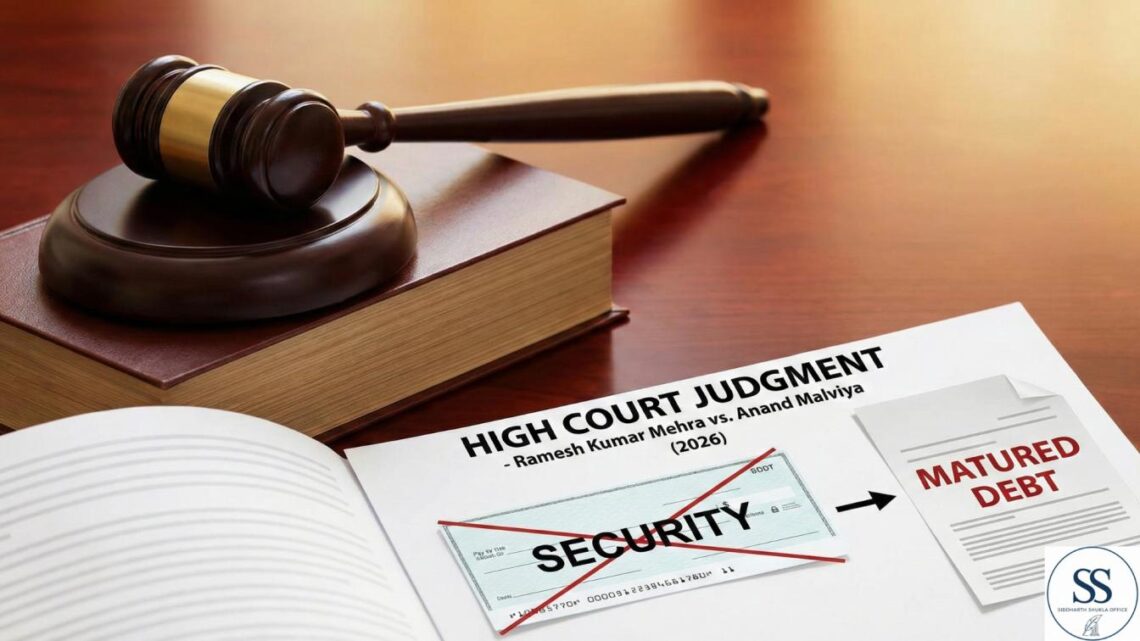

The Madhya Pradesh High Court recently addressed whether a cheque issued as “security” for a loan exempts a borrower from criminal liability under Section 138 of the Negotiable Instruments (N.I.) Act. In the case of Ramesh Kumar Mehra vs. Anand Malviya, the Court overturned an acquittal, ruling that a security cheque matures into a legally enforceable debt once the loan repayment period expires and the debt remains unpaid. The judgment clarifies that the label of “security” does not provide a shield against prosecution if the underlying financial obligation has been triggered by a default.
The Case: Ramesh Kumar Mehra vs. Anand Malviya
The dispute began with a “friendly” loan of ₹2,00,000 given by the complainant to the accused, on April 24, 2015. At the time of the loan, they executed an agreement (Ex.P/1) where the accused handed over two post-dated cheques for ₹1,00,000 each as “security”.
When the accused failed to repay the loan within the agreed six months, the complainant presented the cheques in November 2015, which were returned for “insufficient funds”. While the Trial Court (JMFC, Bhopal) initially convicted the accused, the lower Appellate Court later acquitted him, arguing that the cheques were merely for “security” and not for the discharge of a debt.
The High Court’s Verdict
Hon’ble Shri Justice Rajendra Kumar Vani set aside the acquittal, restoring the conviction and the original sentence of six months’ rigorous imprisonment.
The Court’s reasoning provides three essential lessons for legal practitioners:
- Existing Debt at Disbursement: Since the loan amount was handed over on the same day the agreement was signed, a legally enforceable debt existed from that moment onward.
- The Maturity Rule: A security cheque is not a worthless piece of paper; it matures and becomes eligible for presentation if the borrower fails to repay the loan by the stipulated due date.
- Supreme Court Precedents: The Court followed the principles laid down in Sampelly Satyanarayana Rao and Sripati Singh, confirming that Section 138 applies if a debt is subsisting on the date the cheque is presented.
Final Outcome
The High Court ordered the Trial Court to take the accused into custody to serve his six-month sentence. Additionally, the accused is required to pay ₹2,40,000 in compensation and ₹10,000 in litigation expenses to the complainant.
Key Takeaway: This reinforces that “security cheques” in loan transactions are fully actionable under criminal law once the repayment deadline passes without payment.
Evidence Analysis: Testimony vs. Documents
The Complainant’s Submission
The Appellant argued that the cheques were issued six months after the loan was advanced, following a series of demands for repayment. This position was initially maintained by the complainant during his examination-in-chief.
The Contradictory Evidence (Ex.P/1)
The written loan agreement (Ex.P/1) provided a conflicting timeline that the Court had to reconcile:
- The document explicitly stated that the two post-dated cheques were handed over at the time of receiving the loan.
- The agreement itself was formally executed on April 24, 2015, the same day the loan was disbursed.
How the Court Resolved the Conflict
The High Court acknowledged this variation but ruled in favor of the complainant based on several key legal grounds:
- Failure of Cross-Examination: The defense counsel failed to specifically challenge or prove this variation during the cross-examination of the complainant.
- Unshaken Testimony: The core facts of the loan transaction remained reliable throughout the trial.
- Admission of Free Will: The defense admitted the agreement was executed with “free will and full knowledge,” thereby binding the parties to its written terms.
- Legally Immaterial: Ultimately, the Court held the variation was immaterial because a legally enforceable debt existed by the time the cheques were presented, regardless of the physical date of issuance.
Important Precedents Cited
-
Sripati Singh (since deceased) through his sons Gaurav Singh Vs. State of Jharkhand and another
(2022) 18 SCC 614
Held that a security cheque matures for presentation if the loan is not repaid by the due date, attracting Section 138 consequences upon dishonor.
-
Sampelly Satyanarayana Rao v. Indian Renewable Energy Development Agency Ltd.
(2016) 10 SCC 458
Established that liability under Section 138 depends on the existence of a legally recoverable debt on the date of the cheque.
Frequently Asked Questions: Section 138 & Security Cheques
-
[cite_start]
- The loan was already discharged (repaid) through other modes before the cheque was presented[cite: 147, 148]. [cite_start]
- There was a specific agreement or understanding between the parties to defer the payment or not present the cheque[cite: 143, 148, 169]. [cite_start]
- The debt was not legally enforceable or subsisting on the date the cheque was presented[cite: 113, 131].
Disclaimer
This post is for informational and educational purposes only. It does not constitute legal advice, financial advice, or professional advice of any kind. Laws and their interpretation may vary depending on facts, circumstances, and jurisdiction.
Neither Siddharth Shukla, Advocate, nor any associate, partner, or member of Siddharth Shukla Office, Jabalpur, accepts any responsibility or liability for any loss, damage, or consequence arising from reliance on this content.
Readers are strongly advised to consult a qualified lawyer or appropriate professional for advice specific to their situation. Reading this content does not create a lawyer–client relationship.

