
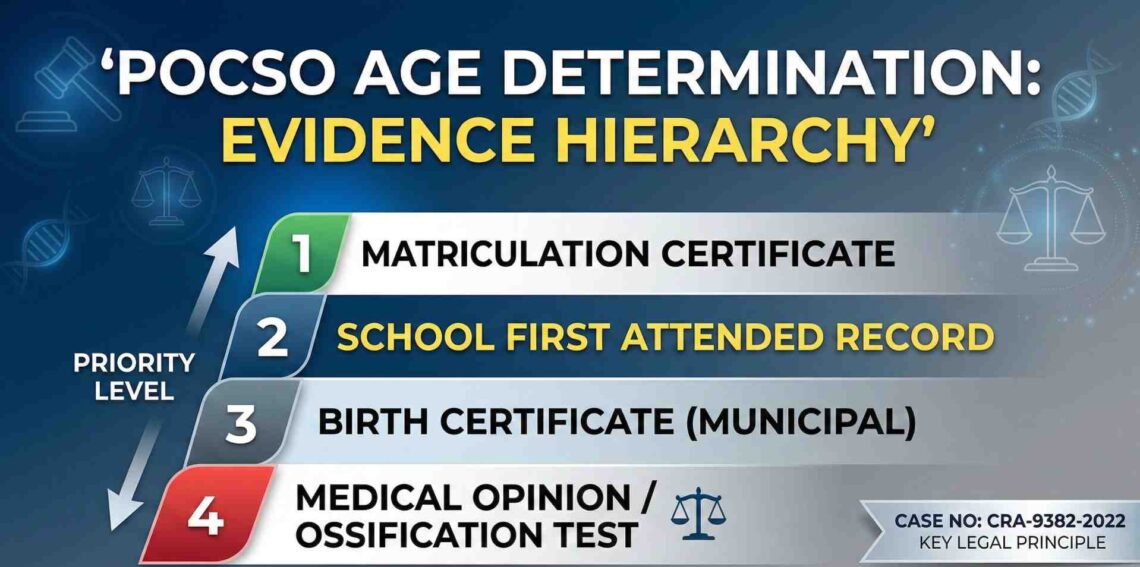
In a recent ruling the hon’ble MP High Court has reaffirmed the hierarchy of evidence for age determination. The court also held that in cases of sexual assault the plea “consensual relationship is wholly inconsequential.
Facts:
On June 25, 2019, the minor prosecutrix went to attend a wedding function near her home but did not return. Her friend, Reena Yadav, witnessed the appellant, Ayyaz Mohammad, and his father forcibly take the victim away while she was going for nature’s call; her screams were drowned out by loud DJ music playing at the event. The victim was recovered from the appellant’s house on June 27, 2019, where she narrated that she had been forcibly confined and raped multiple times against her will.
The trial court convicted the appellant for various offences under the IPC (Sections 343, 363, 366, 368, and 376(2)(n)) and the POCSO Act (Sections 3, 4, 5, and 6) . The appellant challenged this conviction primarily on the grounds of age determination and an alleged relationship with the victim.
The High Court of Madhya Pradesh dismissed the appeal filed by Ayyaz Mohammad, upholding the trial court’s judgment of conviction and sentence.
Principles of Law
The Court reaffirmed the hierarchy of evidence for age determination as per Rule 12 of the Juvenile Justice (Care and Protection of Children) Rules, 2007 (now reflected in Section 94 of the 2015 Act). It held that school records or birth certificates from municipal authorities take precedence over medical opinions . An ossification test is only a secondary tool, and its absence does not vitiate the prosecution’s case if reliable documentary evidence (like a school register) is available.
Furthermore, the Court established that in cases of sexual assault against a minor, the plea of “consensual relationship” or “free will” is legally inconsequential. Once minority is established, any sexual act is deemed non-consensual under the law, regardless of whether the victim accompanied the accused of her own volition.
Age Determination
The core of the appellant’s defense rested on challenging the victim’s age. The defense argued that because the doctor recommended an ossification test that was never conducted, the prosecution failed to prove she was a minor. The Court rejected this, noting that the school scholar register from Navayug Bal Purva Madhyamik Vidyalaya (where she was admitted to Class I) was reliable and recorded her birth date as July 4, 2006. This placed her age at approximately 12 years and 11 months at the time of the incident. The Court clarified that medical tests are only required in the absence of primary documentary evidence
Merits and Evidence
On the merits, the Court found the testimony of the victim (PW-1) to be consistent and corroborated by her friend (PW-4), who was an eyewitness to the abduction. The physical recovery of the victim from the appellant’s house on the third day after the incident was a crucial fact proved by the Investigating Officer (PW-9).
Scientific Corroboration
The prosecution’s case was further solidified by scientific evidence. The Court noted that the DNA report (Ex. P/22) confirmed a positive match between the samples from the victim and the appellant. The Court dismissed the appellant’s alternative defenses, one involving a financial dispute over soil delivery and another claiming a consensual relationship, as untenable given the victim’s age and the overwhelming evidence of forcible confinement.
The court relied on many important Supreme Court precedents:
| Precedent Name | Citation | Summary / Relevance |
|---|---|---|
| Jarnail Singh vs. State of Haryana | (2013) 7 SCC 263 |
Relied Upon Held that Rule 12 of the JJ Rules 2007 applies to victims as well as juveniles. It establishes a “first available basis” hierarchy: 1) Matriculation, 2) School first attended, 3) Birth certificate. If these exist, medical/ossification tests cannot be relied upon. |
| State of Madhya Pradesh vs. Anoop Singh | (2015) 7 SCC 773 |
Relied Upon Confirmed that minor discrepancies in dates between two valid documents (e.g., 2 days difference) are immaterial and do not justify discarding the documents in favor of an ossification test. |
| Sunil vs. State of Haryana | (2010) 1 SCC 742 |
Distinguished The appellant cited this to argue that failure to conduct a referred ossification test is a “serious flaw.” The Court distinguished it, noting that the case did not consider the 2007 JJ Rules and explicitly stated that medical tests are not mandatory in all cases if other primary evidence exists. |
| Mahadeo v. State of Maharashtra | (2013) 14 SCC 637 |
Relied Upon Reinforced that the same “yardstick” used for determining the age of a juvenile in conflict with law must be followed for ascertaining the age of a victim. |
Frequently Asked Questions: Age Determination in POCSO

Siddharth Shukla
Advocate | Criminal Law | POCSO & JJ Act Specialist
Practicing Advocate at the High Court of Madhya Pradesh, Jabalpur. Expert in navigating complex criminal litigation, forensic evidence analysis, and statutory interpretations of the POCSO and Juvenile Justice Acts.

Disclaimer
This post is for informational and educational purposes only. It does not constitute legal advice, financial advice, or professional advice of any kind. Laws and their interpretation may vary depending on facts, circumstances, and jurisdiction.
Neither Siddharth Shukla, Advocate, nor any associate, partner, or member of Siddharth Shukla Office, Jabalpur, accepts any responsibility or liability for any loss, damage, or consequence arising from reliance on this content.
Readers are strongly advised to consult a qualified lawyer or appropriate professional for advice specific to their situation. Reading this content does not create a lawyer–client relationship.

