

Siddharth Shukla
Advocate | Constitutional & Civil Law | Civil Litigation
Advocate at the High Court of Madhya Pradesh with over 13 years of experience. Experience in navigating complex civil litigation, debt recovery, and the enforcement of compromise decrees under the Code of Civil Procedure.

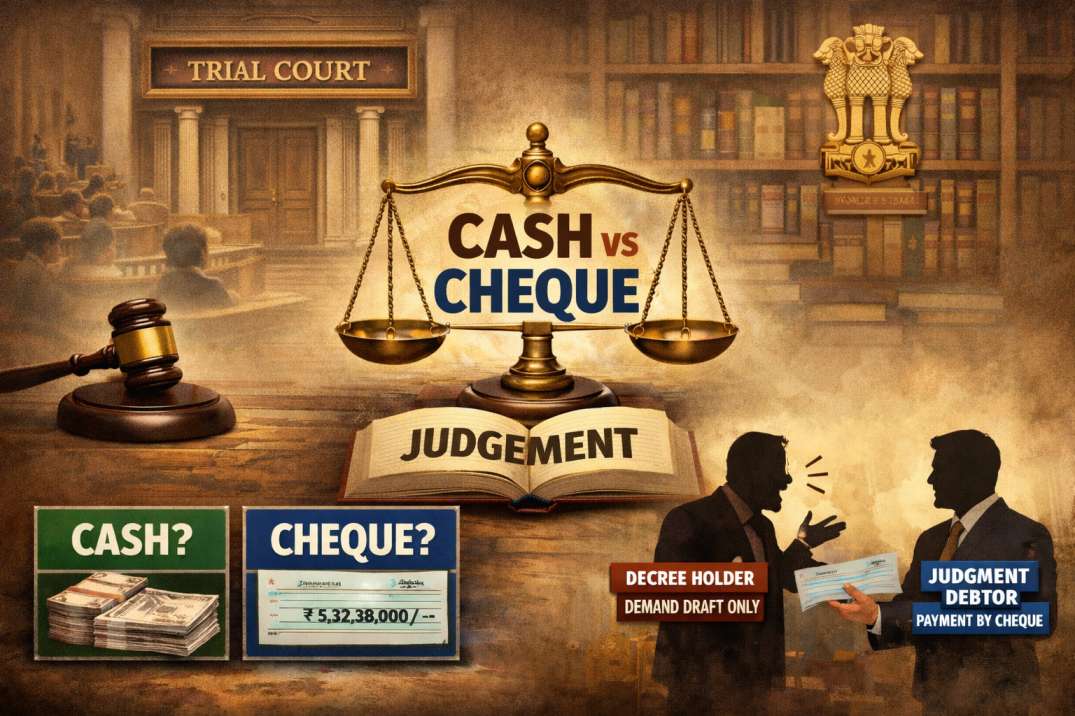
In a significant ruling for civil litigants and execution proceedings, the High Court of Madhya Pradesh (Indore Bench) has reaffirmed that in contemporary society, payment by cheque constitutes a valid legal tender for satisfying a court decree, unless specifically prohibited by the court’s order.
The judgment in Parth Credit and Capital Market Pvt. Ltd. v. Ideal Electronics Pvt. Ltd., delivered by Hon’ble Justice Alok Awasthi, serves as a vital reminder that executing courts cannot become rigid or technical when a judgment debtor demonstrates a bona fide intent to comply with a compromise.
The Dispute: Cash vs. Cheque
The case originated from a compromise decree dated July 20, 2021, where the petitioner (Judgment Debtor) agreed to pay Rs. 5,32,38,000/- within one year to settle two long-standing suits regarding land sale and money recovery.
On July 18, 2022 (just two days before the deadline) the petitioner deposited the full amount via cheques in the Trial Court. However, the respondent (Decree Holder) refused to accept these cheques, demanding instead a Demand Draft and 12% interest. The lower court sided with the respondent, holding that a cheque was not a valid tender.
Key Legal Takeaways
1. The “Relation Back” Doctrine
Citing the Supreme Court in CIT v. Messrs Ogale Glass Works Ltd. and K. Saraswathy v. Somasundaram Chettiar, the High Court emphasized that:
- A cheque is a negotiable instrument and represents cash in modern business practice.
- If a cheque is subsequently honored, the date of payment relates back to the date the cheque was delivered or deposited.
- Since the compromise decree did not expressly mandate “cash only,” the cheque was a lawful discharge of the debt.
2. Executing Courts Cannot “Go Beyond the Decree”
The High Court observed that the executing court erred by entertaining demands for interest and specific modes of payment (like Demand Drafts) that were never part of the original compromise agreement. An executing court is bound by the terms of the decree and cannot invent new conditions.
3. Clarification on Res Judicata
The respondent argued the petition was barred because a previous objection had been rejected. The High Court clarified that Res Judicata only applies if the specific issue (in this case, the application under Order XXI Rule 2 CPC) was actually adjudicated on its merits. Since the lower court had previously only rejected a general objection without deciding on the validity of the cheque deposit, the petitioner was free to challenge the matter.
The Final Verdict
The High Court quashed the lower court’s order. To ensure finality and fairness, the Court directed the petitioner to:
- Deposit the amount of Rs. 5,32,38,000/- via a new cheque within 30 days.
- Include 12% simple interest from the date of the original tender (July 18, 2022) to account for the intervening delay.
| Precedent Name | Citation | Summary / Relevance |
|---|---|---|
| K. Saraswathy v. P.S.S. Somasundaram Chettiar | AIR 1989 SC 1553 |
Relied Upon Held that payment by cheque is an ordinary incident of modern life. Unless cash is specifically required, payment by cheque is “due payment” if honored later. |
| CIT, Bombay v. Messrs Ogale Glass Works Ltd. | AIR 1954 SC 429 |
Relied Upon Established that when a cheque is honored, the date of payment relates back to the date the cheque was delivered or posted. |
| Damadilal and Others v. Parashram and Others | (1976) 4 SCC 855 |
Relied Upon Confirmed that tendering rent/debt by cheque is a valid tender in contemporary society; implied agreement is inferred unless stated otherwise. |
| Satyadhyan Ghosal v. Sm. Deorajin Debi | AIR 1960 SC 941 |
Distinguished Discussed the doctrine of res judicata at different stages. Found inapplicable here as the specific issue was not previously decided. |
| Vijay Laxmi Singh v. Registrar of Coop. Societies | W.P.(C) 6312/2022 (Delhi HC) |
Relied Upon Reaffirmed that tendering cheques is as good as cash under the Negotiable Instruments Act and Supreme Court dicta. |
| Smt. J. Yashoda v. Smt. K. Shobha Rani | AIR 2007 SC 1721 |
Distinguished Cited by the respondent but found factually inapplicable to the present case. |
Decree Satisfaction & Cheque Payments
Legal Guidelines & FAQs
Disclaimer
This post is for informational and educational purposes only. It does not constitute legal advice, financial advice, or professional advice of any kind. Laws and their interpretation may vary depending on facts, circumstances, and jurisdiction.
Neither Siddharth Shukla, Advocate, nor any associate, partner, or member of Siddharth Shukla Office, Jabalpur, accepts any responsibility or liability for any loss, damage, or consequence arising from reliance on this content.
Readers are strongly advised to consult a qualified lawyer or appropriate professional for advice specific to their situation. Reading this content does not create a lawyer–client relationship.

