
Petitioner was an elected official, and her peers vote her out of office. But what if the formal letter inviting her to that exact meeting arrived a few days late? Does a technical delay invalidate a democratic vote?
In a recent judgment by the High Court of Madhya Pradesh, the Court tackled this exact question, delivering a clear message on the balance between administrative procedure and democratic mandates.
This blog is a simplified breakdown of the case, the legal battle, and why the Court ruled the way it did, focusing on the core arguments between the petitioner (the ousted Sarpanch) and the respondents (the State authorities and the opposing Panchs).
The Facts: A Sarpanch Loses Support
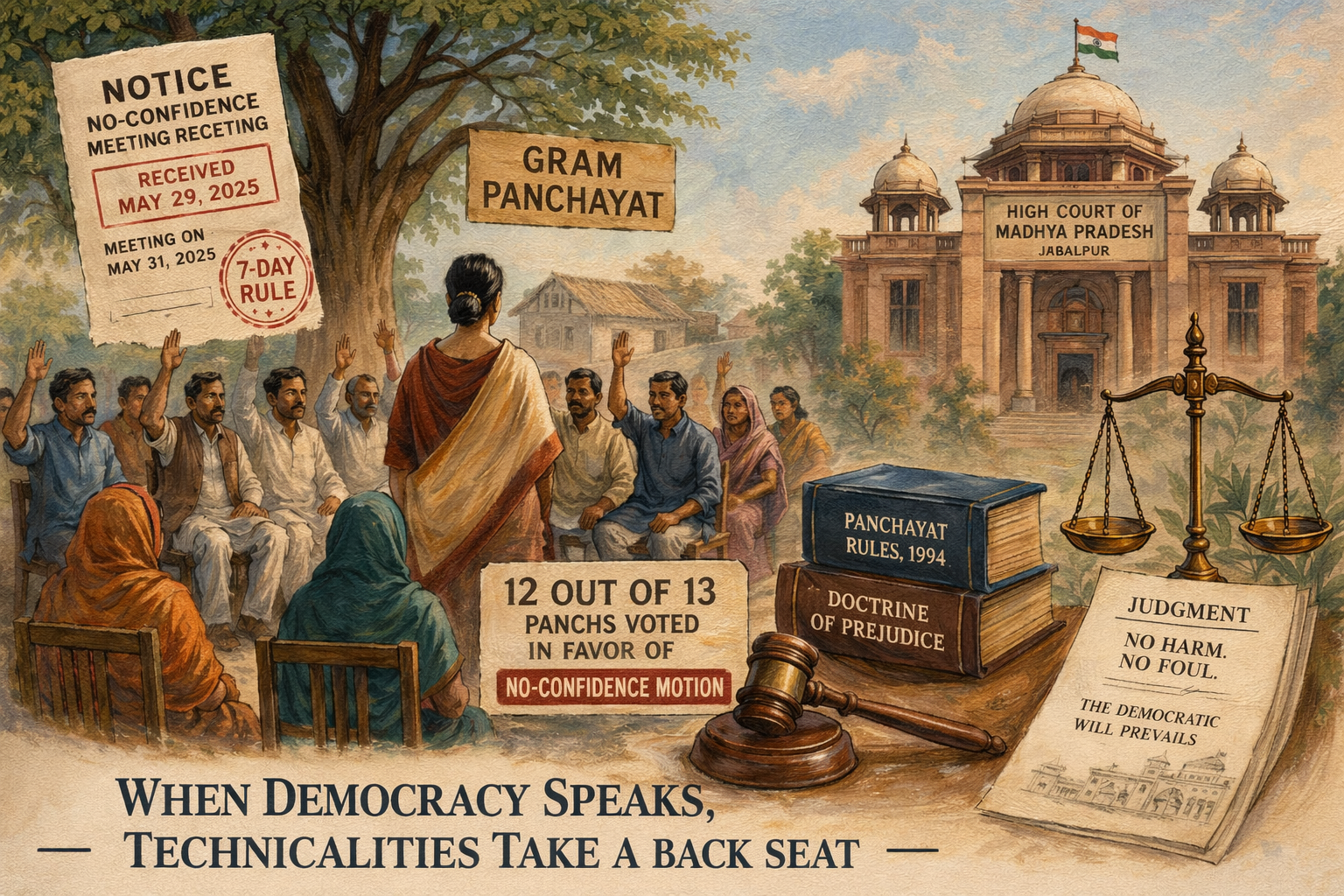
The petitioner assumed office as the elected Sarpanch of her Gram Panchayat on July 14, 2022. Fast forward to 2025, and the political tides had turned. A No-Confidence Motion was initiated against her, backed by the signatures of 13 Panchs who wanted her removed.
The Sub-Divisional Officer (SDO), acting as the prescribed authority (and a respondent in the case), scheduled a meeting for May 31, 2025, to officially vote on this motion.
The Legal Loophole: The 7-Day Rule
This is where the law gets specific. Under Rule 3(3) of the M.P. Panchayat Rules of 1994, a notice for a No-Confidence Motion meeting must be dispatched to every member at least 7 clear days before the meeting takes place.
The petitioner argued a major technicality: she claimed she only received the official notice on May 29, 2025 which was just two days before the crucial vote. As the respondent authorities failed to follow this mandatory 7-day rule, she argued the entire proceeding was illegal and should be declared null and void.
The Vote
Despite the delayed receipt of the notice, the meeting went ahead as planned. The petitioner attended, and the democratic process unfolded. Out of the 13 Panchs present (including the petitioner), an overwhelming 12 voted in favor of the No-Confidence Motion, officially removing her from power.
The Court’s Verdict: No Harm, No Foul
The High Court had to decide whether a procedural flaw (the late notice) was enough to overturn a clear democratic outcome.
The Court dismissed the petitioner’s case, leaning heavily on the Doctrine of Prejudice. Here is the core reasoning:
- Procedure is not always fatal: While mandatory laws usually require strict compliance, a procedural slip-up does not automatically nullify the entire action.
- Did it cause real harm? The ultimate test is whether the mistake caused “serious prejudice” to the petitioner or resulted in a failure of justice.
- The Democratic Will Prevails: Because the petitioner was fully aware of the proceedings, actively participated in the meeting, and was ultimately voted out by a massive two-thirds majority of the Panchs, the late notice didn’t actually harm her ability to defend herself. The democratic voice of the Panchayat was crystal clear.
Conclusion
This judgment is a fascinating reminder of how the law works in practice. Procedural rules like the 7-day notice exist to protect people from being ambushed. However, the Courts will not allow technicalities to be weaponized by a petitioner to suppress a legitimate democratic majority. In the eyes of the law, if the process was fair enough and the numbers are undeniable, the will of the people stands.
Frequently Asked Questions
Key Takeaways
- Substance Over Procedure (The Doctrine of Prejudice): The most critical takeaway is that a mere technical violation of a mandatory procedural rule—such as failing to provide a full 7-day advance notice—does not automatically invalidate an entire legal or administrative proceeding. The courts will ask: Did this error actually cause serious prejudice or a failure of justice?
- The Democratic Mandate Prevails: Courts are highly reluctant to overturn the clear, democratic will of an elected body based solely on administrative hiccups. If a No-Confidence Motion is passed by the requisite statutory majority (in this case, 12 out of 13 present members), that numerical mandate holds massive legal weight.
- Active Participation Limits Grievances: If an individual claims they were not given proper legal notice but still manages to attend and actively participate in the proceedings, their argument for being “prejudiced” is severely weakened. The petitioner’s presence at the vote essentially proved she had a fair opportunity to face the motion.
- Legislative Intent Guides Interpretation: When evaluating broken rules, the Court looks at the broader intent of the law. The intent behind the Panchayat Rules was to ensure a meeting happens reasonably fast (within 15 days) and that members are informed. Because the meeting happened within the 15-day limit and members were informed (even if a bit late), the core intent of the law was satisfied.
- Waiver of Rights: Drawing from the precedents cited (like Dhumadhandin v. State of M.P.), if an elected official takes a chance by facing a No-Confidence Motion without immediately challenging the validity of the notice beforehand, they generally waive their right to use that procedural flaw as a defense later if they lose the vote.
Court: In the High Court of Madhya Pradesh at Jabalpur
Presiding Judge: Hon’ble Shri Justice Vishal Mishra
Date of Judgment: 22nd of January, 2026
Case Number: Writ Petition No. 34643 of 2025
Neutral Citation: 2026:MPHC-JBP:16257
Full Judgment:
Read Full Judgment

By Advocate Siddharth Shukla
MP High Court, Supreme Court of India
Practising lawyer at the High Court of Madhya Pradesh and Tribunals, with many years of extensive experience in constitutional, criminal, and civil litigation. Dedicated to providing impeccable analytical legal insights and effective representation in high-stakes litigation.
