
When a railway employee transitions from a physically demanding “running” post to a “stationary” role, they often face administrative hurdles regarding their pay fixation. A recurring flashpoint is the “Running Allowance”—a special pay element granted to running staff. What happens to this allowance when an employee clears a competitive exam and secures a higher-grade stationary post?
The High Court of Madhya Pradesh recently delivered a decisive verdict on this issue, bringing massive relief to affected employees by quashing arbitrary recoveries and clarifying the law on limitation in service matters.
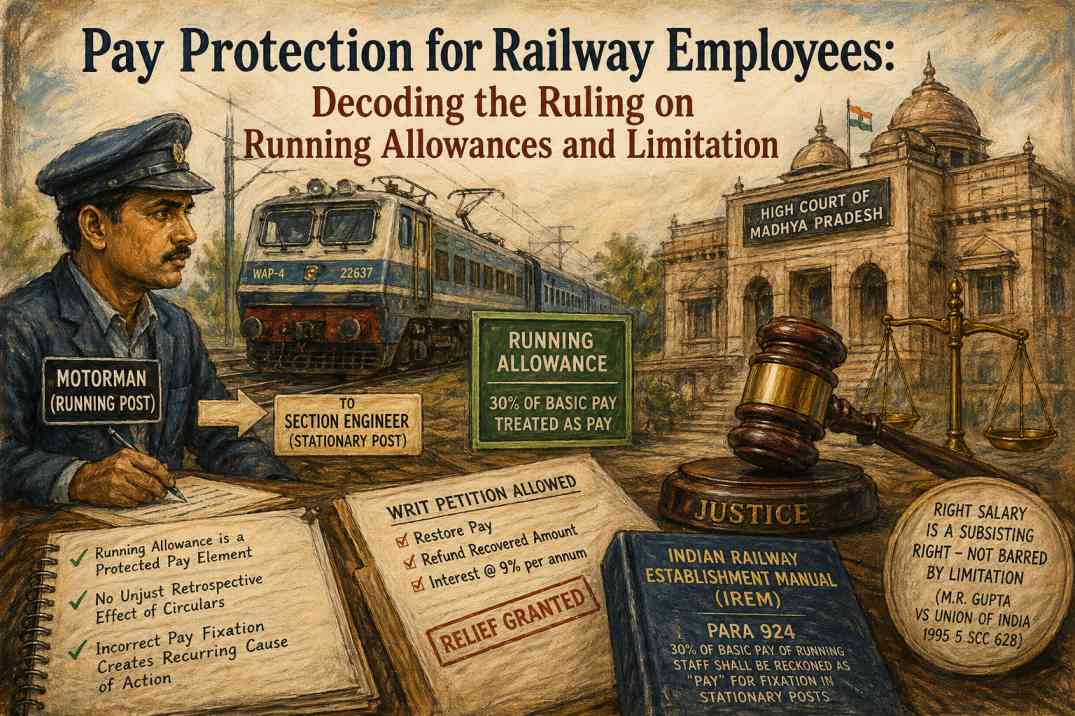
The Core Dispute: From Motorman to Section Engineer
The factual matrix of the case is straightforward but incredibly common in railway administration.
The petitioner was initially serving as a Motorman (a running category post) in the pay scale of Rs. 5,500-9,000/-. Aspiring for career progression, he appeared for a competitive selection process conducted by the Railway Recruitment Board (RRB), Mumbai. He was successfully appointed as a Section Engineer (a stationary post) in the higher pay scale of Rs. 6,500-10,500/- and joined the post on March 9, 2000.
In April 2000, the Railway Department rightfully fixed his new basic pay by including a 30% pay element derived from his running allowance.
However, the peace was short-lived. Relying on a subsequent Railway Board Circular dated September 15, 2006, the authorities abruptly withdrew this 30% benefit with retrospective effect from September 2006. Worse still, they ordered a monthly recovery of Rs. 2,581/- from his salary, to be deducted over 72 installments.
When the petitioner approached the Central Administrative Tribunal (CAT), his Original Application was dismissed without going into the merits, purely on the ground of the limitation period.
The High Court’s Intervention: Key Legal Principles
The High Court meticulously dismantled the Department’s stance and the Tribunal’s dismissal, reinforcing three critical pillars of service jurisprudence:
- 1. Running Allowance is a Protected Pay Element: The Court highlighted Para 924 of the Indian Railway Establishment Manual (IREM), which unequivocally states that 30% of the basic pay of running staff shall be reckoned as “pay” for the fixation of pay in stationary posts. The Court noted that even if the employee was selected through an open RRB competition for a higher post, his existing pay had to be protected. The running allowance, being a vested pay element, could not be artificially separated during his pay fixation.
- 2. Executive Circulars Cannot Have Unjust Retrospective Effect: The Department’s reliance on the 2006 Circular was fundamentally flawed. The Court observed that Para 3 of the said circular explicitly stated that past cases should not be reopened. Since the petitioner was appointed and his pay was fixed back in the year 2000, applying a 2006 circular to deduct his pay and order recoveries was legally impermissible.
- 3. Incorrect Pay Fixation is a “Recurring Cause of Action”: Perhaps the most significant takeaway for practitioners is the Court’s stance on limitation. Quashing the CAT’s order, the High Court relied heavily on the Supreme Court’s landmark judgment in M.R. Gupta v. Union of India (1995 5 SCC 628). The Court reiterated that the right to receive the correct salary is a subsisting right that continues throughout an employee’s service tenure. Because improper pay fixation creates a “recurring cause of action” every time a deficient salary is paid, standard limitation bars do not apply.
The Final Verdict
Delivering substantial justice, the High Court set aside the CAT’s 2024 order and allowed the petitioner’s Original Application.
The Court issued a powerful writ of mandamus, directing the Railway authorities to:
- Restore the petitioner’s pay as it was initially granted.
- Refund every single rupee recovered under the impugned 2007 order.
- Pay Interest at the rate of 9% per annum on the recovered amount, calculated from the date of recovery until the date of actual payment.
Concluding Thoughts
Jitendra Shrivastava v. Union of India serves as a vital precedent against the bureaucratic tendency to unilaterally reinterpret pay rules to the detriment of employees. It reaffirms that statutory pay protections for running staff are robust and that the technical defense of “limitation” cannot be used as a shield by the State to perpetuate a continuous financial wrong against its workforce.
What is a running post?
Employees in running posts are the operational crew who travel on the trains. Because their duties require them to be constantly on the move, work irregular hours, and frequently stay away from their home headquarters, their service conditions are treated differently from standard office workers. The petitioner initially worked as a Motorman, which is explicitly recognized as a running category.
Examples : Motorman and Electrical Assistant Drivers
To compensate for the physically demanding and itinerant nature of these roles, the Railways pay these employees a special financial benefit known as a “Running Allowance”. Because this allowance makes up a significant portion of their take-home salary, the railway rules mandate that 30% of this allowance is legally classified as “pay” (a core pay element).
What is a stationary post?
A running post is the exact opposite of a “stationary post”. A stationary post involves working at a fixed location, such as a railway station, administrative office, or workshop. Examples include the Section Engineer and the Enquiry-cum-Reservation Clerk (ECRC)
The core legal dispute in this matter arose precisely because the employee transitioned from a mobile “running post” to a fixed “stationary post,” raising the question of whether his special running allowance should be protected in his new salary structure.
| S.No. | Case Name | Citation | Treatment by Court | Principle / Ratio Decidendi |
|---|---|---|---|---|
| 1 | G.C. Ghosh v. Union of India | 1991 Supp. (2) SCC 497 | Relied Upon | A portion of running allowance is treated as part of pay when a railway employee is transferred or promoted to a stationary post. |
| 2 | Rajeev Mishra v. Union of India | O.A. No. 408/2004 (CAT Allahabad, 10.03.2005) | Discussed Relied | 30% of running allowance must be considered for pay fixation when shifting from a running post to a stationary role like ECRC. |
| 3 | Union of India v. Shubhasis Halder | Writ Petition No. 33309/2011 (Allahabad HC, 01.02.2012) | Discussed Relied | Court upheld protection of 30% pay element and rejected recovery from employees transitioning to stationary posts. |
| 4 | M.R. Gupta v. Union of India | (1995) 5 SCC 628 | Relied Upon | Pay fixation errors create a continuing cause of action; claims are not barred by limitation and persist throughout service. |
Disclaimer
This post is for informational and educational purposes only. It does not constitute legal advice, financial advice, or professional advice of any kind. Laws and their interpretation may vary depending on facts, circumstances, and jurisdiction.
Neither Siddharth Shukla, Advocate, nor any associate, partner, or member of Siddharth Shukla Office, Jabalpur, accepts any responsibility or liability for any loss, damage, or consequence arising from reliance on this content.
Readers are strongly advised to consult a qualified lawyer or appropriate professional for advice specific to their situation. Reading this content does not create a lawyer–client relationship.

By Advocate Siddharth Shukla
MP High Court, Supreme Court of India
Practising lawyer at the High Court of Madhya Pradesh and Tribunals, with many years of extensive experience in constitutional, criminal, and civil litigation. Dedicated to providing impeccable analytical legal insights and effective representation in high-stakes litigation.
