Category Legal

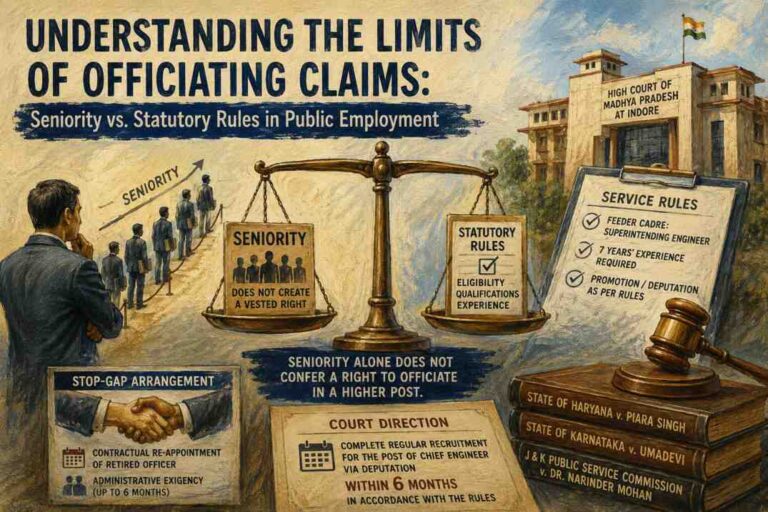
Understanding the Limits of Officiating Claims: Seniority vs. Statutory Rules in Public Employment

In Satyabir Singh v. M.P. Industrial Development Corporation Ltd., the High Court of Madhya Pradesh held that seniority alone does not create an automatic right to hold a higher officiating post. The judgment reaffirms that candidates must meet the foundational statutory eligibility criteria, and clarifies that state contractual rules requiring cabinet approval do not apply to autonomous corporate bodies.

Cheque as Valid Tender in Decree Satisfaction

MP High Court ruling on cheque vs cash payment in execution proceedings under civil procedure law.

In a significant ruling, the Madhya Pradesh High Court (Indore Bench) has clarified that payment by cheque constitutes a valid legal tender for satisfying a court decree unless the decree specifically requires another mode of payment.

In Parth Credit and Capital Market Pvt. Ltd. v. Ideal Electronics Pvt. Ltd., Justice Alok Awasthi held that an executing court cannot impose new conditions beyond the terms of the decree. The Court emphasized that in modern commercial practice a cheque represents cash, and if honored, payment legally relates back to the date of its tender.

The ruling reinforces a key principle of execution law: courts must prioritize substance over technical objections when a judgment debtor shows bona fide intent to comply with a compromise decree.