
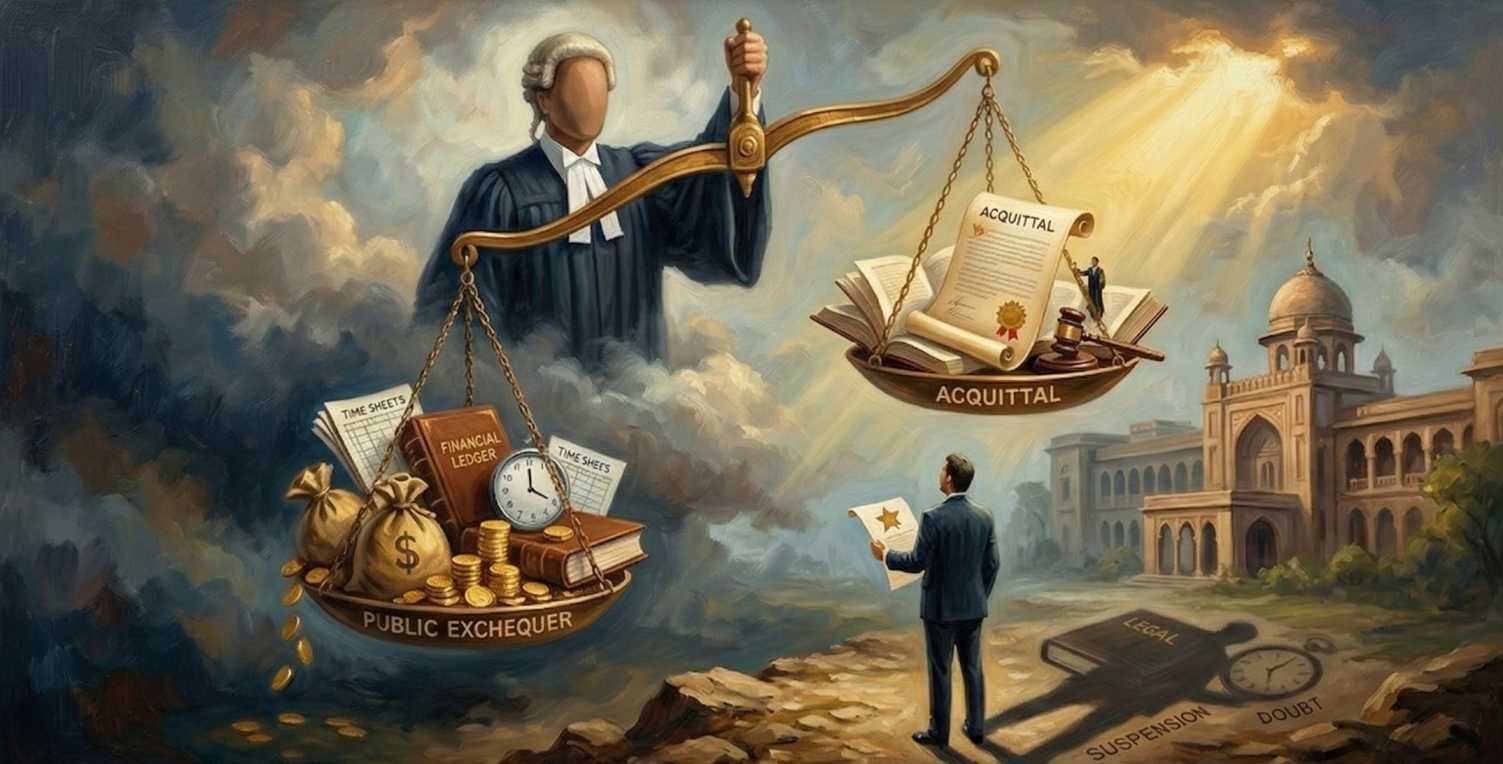
For any public servant, a criminal charge is a double-edged sword: there is the battle for your reputation in court, and then there is the battle for your livelihood with the Department. A common misconception is that a “Clean Chit” or an acquittal automatically triggers a refund of all withheld salaries during suspension.
In a recent judgment, Vijay Kumar Sharma v. M P M K V V Com Ltd and Others (2026:MPHC-GWL:3951), the High Court of Madhya Pradesh (Gwalior Bench), has clarified that the road to back wages is not straight-forward.
The Case Study: Vijay Kumar Sharma’s Battle
Mr. Sharma, a Junior Engineer, was suspended in 2018 following corruption charges. He retired on superannuation in 2021 while still under suspension. A year later, in 2022, the Trial Court acquitted him of all charges.
While the Department treated his suspension period as “on duty” for retirement benefits, they denied him pay and allowances for those three years. Mr. Sharma challenged this, but the High Court affirmed the Department’s right to withhold his salary.
The Law: Fundamental Rule 54-B
The core of these disputes lies in Fundamental Rule 54-B. The rule dictates that back wages are not a right, but a matter of the Department’s “opinion”.
| Condition | Outcome |
| If suspension is deemed “Wholly Unjustified” | Full Pay and Allowances. |
| If suspension was Statutorily Mandatory | No Back Wages (usually). |
| If the employee caused the delay | Partial or No Pay. |
Why “Acquittal” is Not Always Enough
The Court established a crucial distinction: a suspension is only “wholly unjustified” if the authority had no legal grounds to issue it at the start when it was imposed.
- Mandatory Suspension: Under Rule 9 of the M.P. Civil Services Rules, 1966, if a public servant is charged with corruption or moral turpitude, the Department must suspend them.
- The “No Work, No Pay” Principle: The Court relied on Supreme Court precedents (like RBI v. Bhopal Singh Panchal) to argue that if the Department didn’t start the criminal case, they shouldn’t be penalized for your absence.
- Self-Disabling Act: By getting involved in a criminal case, an employee “disables himself” from performing duties.
Strategic Takeaways for Public Servants
If you are facing a similar situation, remember these three legal realities:
- The Nature of Acquittal Matters: An acquittal based on “benefit of doubt” or “hostile witnesses” gives the Department more power to deny back wages than a “clean” or “honourable” acquittal.
- Discretion is Not Absolute: While the Department has the power to decide, that power must be exercised reasonably and not arbitrarily.
- Timing is Everything: Once the competent authority exercises its discretion based on the facts of the case, Courts are hesitant to interfere unless there is a grave error in law.
“The law obliges a person involved in a crime to be kept out of service; the Department cannot be faulted for following that law.” — High Court of Madhya Pradesh, 2026.
| Precedent | Citation | Summary/Application in this Case |
|---|---|---|
| Raj Narain v. Union of India | (2019) 5 SCC 809 | Held that an employee involved in a crime disables himself from rendering service; subsequent acquittal does not automatically entitle him to back wages. |
| Greater Hyderabad Municipal Corpn. v. M. Prabhakar Rao | (2011) 8 SCC 155 | Reinforced that the competent authority must form an opinion on whether suspension was “wholly unjustified” and has the power to deny salary even upon exoneration to maintain discipline. |
| Union of India v. K.V. Jankiraman | (1991) 4 SCC 109 | Established that there is no “inflexible rule” for full salary upon exoneration. Such a rule would undermine administrative discipline and public interest. |
| Reserve Bank of India v. Bhopal Singh Panchal | (1994) 1 SCC 541 | Asserted the “no work, no pay” principle; the employer is not responsible for the employee’s absence due to misconduct and cannot be “saddled with the liability” of back wages. |
| Union of India v. Jaipal Singh | (2004) 1 SCC 121 | Held that if the department did not initiate the prosecution, it cannot be faulted for keeping the employee out of service, as the law obliges a person under trial/conviction to be kept away. |
| Sukhdarshan Singh v. State of Punjab | (2024) 14 SCC 531 | Clarified that even if termination is found illegal by an appellate authority, it does not ipso facto follow that the employee is entitled to salary for the entire period. |
Frequently Asked Questions
Suspension, Acquittal, and Back Wages
Navigating the aftermath of a criminal case as a public servant can be as taxing as the trial itself. Here are the answers to common questions regarding your rights.
1. Does a court acquittal automatically entitle me to full back wages for my suspension period?
2. What exactly does “wholly unjustified” mean in the eyes of the law?
3. Can my department deny me salary even if the trial court gave me a “clean chit”?
4. What if I retired while the criminal case was still pending?
5. Does the type of acquittal matter (e.g., “Honourable” vs. “Benefit of Doubt”)?
6. Can I challenge the department’s decision in the High Court?
Disclaimer
This post is for informational and educational purposes only. It does not constitute legal advice, financial advice, or professional advice of any kind. Laws and their interpretation may vary depending on facts, circumstances, and jurisdiction.
Neither Siddharth Shukla, Advocate, nor any associate, partner, or member of Siddharth Shukla Office, Jabalpur, accepts any responsibility or liability for any loss, damage, or consequence arising from reliance on this content.
Readers are strongly advised to consult a qualified lawyer or appropriate professional for advice specific to their situation. Reading this content does not create a lawyer–client relationship.

By Advocate Siddharth Shukla
MP High Court, Supreme Court of India
Practising lawyer at the High Court of Madhya Pradesh and Tribunals, with many years of extensive experience in constitutional, criminal, and civil litigation. Dedicated to providing impeccable analytical legal insights and effective representation in high-stakes litigation relating to service jurisprudence and complex administrative matters.
