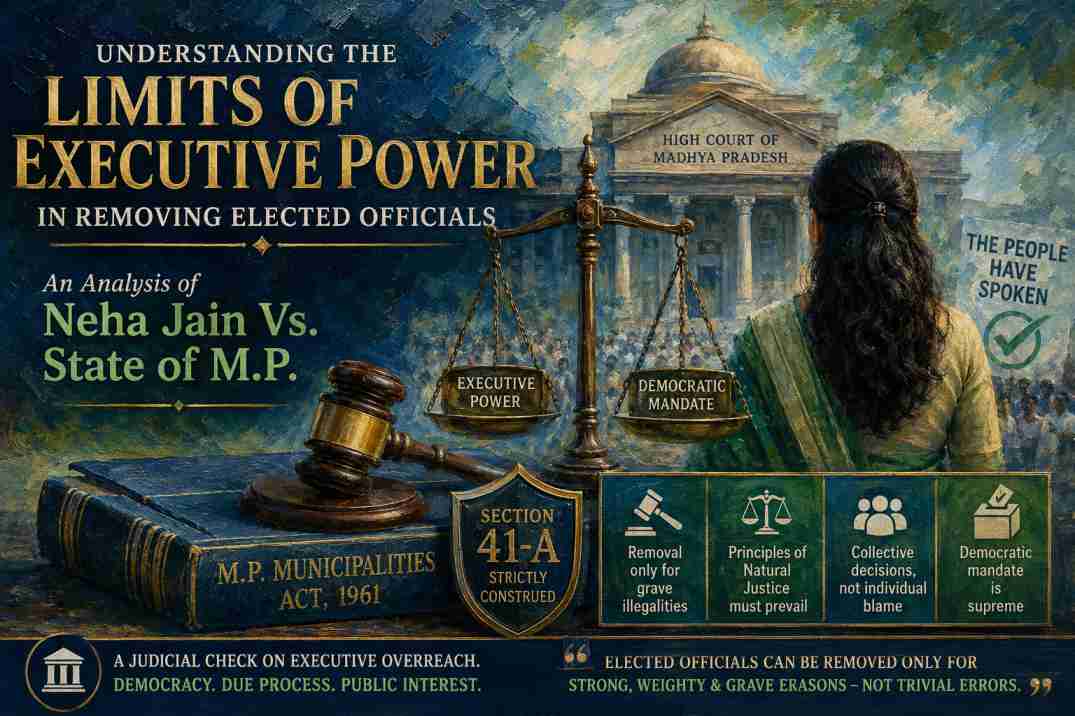
The democratic fabric of local self-government relies heavily on the autonomy and security of tenure of elected representatives. A critical legal safeguard for these officials is the strict limitation placed on the executive branch regarding their removal from office. This article, which analyses recent decision by High Court of Madhya in the case of Neha Jain Versus The State of Madhya Pradesh and Others, WP-34618-2025, provides a comprehensive look at the limits of state power under Section 41-A of the M.P. Municipalities Act, 1961.
The Factual Matrix
The dispute centered around the petitioner, who was the duly elected President of the Municipal Council, Deori, District Sagar. She approached the High Court to challenge an administrative order dated 25.08.2025, which mandated her removal from the post of President under Section 41-A of the M.P. Municipalities Act, 1961.
The State Government had issued a show-cause notice leveling four primary charges against her:
1. Irregular appointment of 13 daily-wage muster roll employees without competent approval.
2. Failure to constitute the President-in-Council (PIC) as mandated by Section 70 of the Act, thereby paralyzing administrative and financial functions.
3. Alleged embezzlement of Rs. 30 Lakhs, a charge that the inquiry committee ultimately found unproved.
4. Discrepancies and alleged financial loss in the procurement of Air Conditioners for a municipal building.
The Defense and Administrative Oversights
In her comprehensive defense, the petitioner clarified that the actions undertaken were not singular, autocratic decisions. The appointment of the 13 muster roll employees was done following an explicit approval from the President-in-Council. Regarding the procurement of Air Conditioners, she presented evidence that the purchases were made strictly through the government’s official GEM portal after PIC approval, inherently negating the possibility of financial misappropriation.
Furthermore, she highlighted that the delay in forming the President-in-Council was not due to her negligence. She had repeatedly issued notices for sessions, but rival corporators deliberately boycotted the meetings to obstruct municipal functioning. The High Court observed that the state authorities failed to properly analyze this detailed reply, displaying a clear non-application of mind.
Key Legal Precedents and Principles
The High Court meticulously evaluated the legal standards required to unseat a democratically elected official, relying on a robust framework of Supreme Court and High Court jurisprudence:
- Sharda Kailash Mittal Vs. State of M.P. and others, (2010) 2 SCC 319: The Court heavily relied on this Supreme Court judgment to establish that the extreme power of removal under Section 41-A lacks detailed statutory guidelines and must therefore be construed very strictly. The Supreme Court held that removal can only be invoked for very strong and weighty reasons or grave illegalities, not for minor administrative irregularities.
- Ravi Yashwant Bhoir Vs. District Collector, Raigad and others, (2012) 4 SCC 407: This precedent was utilized to affirm that removing a duly elected member casts a severe stigma and strips away a valuable statutory right. The Supreme Court ruled that such a quasi-judicial proceeding requires a full-fledged inquiry and strict adherence to the principles of natural justice.
- Tarlochan Dev Sharma Vs. State of Punjab and others, (2001) 6 SCC 260: Citing this case, the Court reiterated that an elected official holds a valuable statutory right to complete their term. Their removal is a serious matter that cannot be executed merely at the behest of political rivals or without an independent, discretionary application of mind by the statutory authority.
- Rajiv Sharma Vs. State of M.P. and others, 2003 (4) MPLJ 28: The High Court referred to this judgment to cement the principle that removal under Section 41-A must be strictly in the public interest, and the alleged irregularities must be so severe that the official’s continuation becomes completely undesirable.
The Mandate of the Electorate and the Final Verdict
A highly consequential development occurred during the pendency of the writ petition. The State Election Commission proceeded to conduct a recall election under Section 47 of the Act on 19.01.2026. The results unequivocally favored the petitioner. Out of the 13367 total votes cast, nearly 50 percent of the electorate voted against recalling her, meaning the attempt to unseat her democratically failed entirely.
Relying on the judicial precedents which distinguish between mere administrative lapses and grave misconduct, coupled with the undeniable democratic mandate reaffirmed during the recall election, the High Court found the state’s executive action to be unsustainable. Consequently, the Court quashed the impugned order dated 25.08.2025 and allowed the writ petition, thereby reinstating the petitioner.
Conclusion
The ruling in Neha Jain Versus The State of Madhya Pradesh and Others, WP-34618-2025, serves as a crucial constitutional check on executive overreach. It legally solidifies the doctrine that an elected representative cannot be singularly punished for collective council decisions, nor can they be unceremoniously removed for trivial administrative errors. The judgment reinforces the supremacy of the democratic mandate and ensures that statutory powers of removal are reserved exclusively for the rarest of cases involving profound public interest and proven, grave misconduct.
Frequently Asked Questions (FAQs)
Key Takeaways
For Elected Officials (Litigants)
- Secure Collective Approvals: Ensure major administrative decisions, financial procurements, and employee appointments are formally approved by the President-in-Council (PIC).
- Maintain Transparent Records: Use official government platforms like the GEM portal for procurement to shield against allegations of embezzlement.
- Document Obstructions: Formally record any deliberate boycotts or obstruction by council members and notify higher authorities promptly.
For Legal Practitioners
- Challenge Non-Application of Mind: Scrutinize inquiry reports to determine whether authorities genuinely considered the substantive defenses raised.
- Leverage Supreme Court Precedents: Rely on cases like Ravi Yashwant Bhoir and Sharda Kailash Mittal to emphasize the high threshold for removing elected officials.
For Government & Executive Authorities
- Exercise Extraordinary Powers Sparingly: Removal under Section 41-A should never become a routine administrative weapon or political tool.
- Ensure Substantive Natural Justice: Authorities must objectively evaluate replies and provide compelling reasons before unseating an elected representative.
This content is published solely for informational and educational purposes. It does not constitute legal advice, financial advice, or professional consultation of any kind. Laws, judicial interpretations, and procedural requirements may vary depending upon the facts, circumstances, and jurisdiction involved.
Neither Advocate Siddharth Shukla, nor any associate, affiliate, partner, or member of Siddharth Shukla Office, Jabalpur, accepts any liability, responsibility, or obligation for any loss, consequence, or damage arising out of reliance upon this material.
Readers are strongly advised to consult a qualified legal professional for advice tailored to their individual circumstances. Viewing or reading this content does not create a lawyer–client relationship.

Advocate Siddharth Shukla
Practising Advocate at the High Court of Madhya Pradesh and various tribunals, with extensive experience in constitutional, civil, criminal, and commercial litigation. Focused on delivering strategic legal solutions, analytical insights, and effective representation in complex disputes and high-stakes matters.
